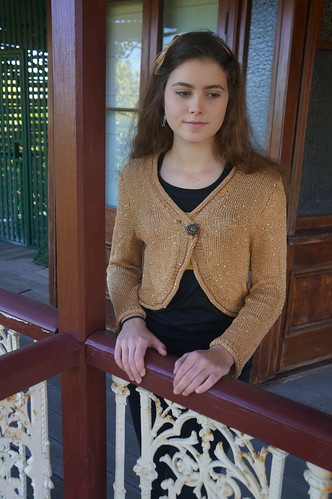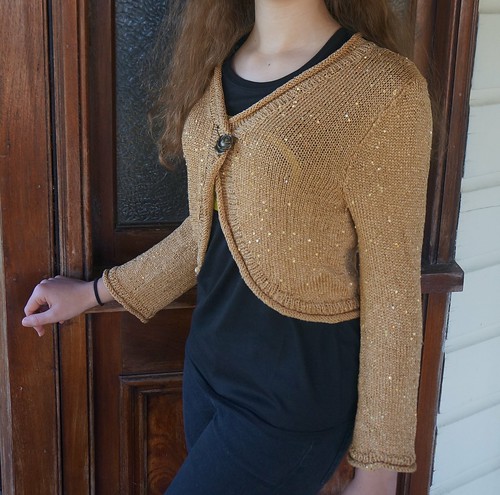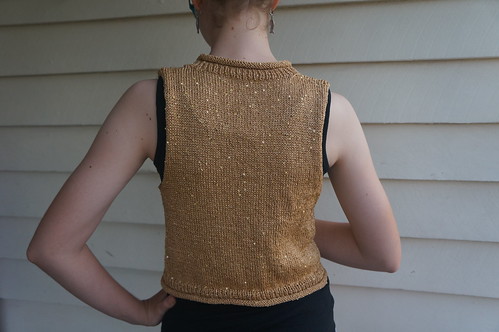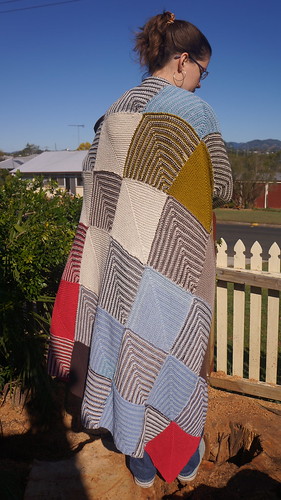
We are seeing quite a few of these quick and gorgeous scarves coming into the shop. This one is by Sue, from one skein of Aslan Trends Artesenal in colour 36. The official name for this colour is "Celery" but Sue has renamed it "Avocado" as a more suitable vegetable/fruit for Queensland. I think it looks a bit like the shade of the flesh of a Reed avocado - What do you think? Sue plans to sew some beads in different natural timbers to the ends of this scarf, and promises to bring it in to show us once it is embellished. I am really enjoying all the variations our knitters develop from this simple pattern.
I am also waiting to see the final version of a stole/scarf made using this pattern in the bulky weight Jo Sharp Silkroad Ultra. Jessica is making one for her sister to wear in the snow during a trip to the USA this Christmas. So now the Monday night knit group is also an international designer :).
Wednesday, November 11, 2009
Monday, November 9, 2009
Another Jo Sharp Ultra Beret Pattern
A few months ago, I made a black beret from Jo Sharp's Silkroad Ultra. The Beret was doing display duty in the shop once my daughter felt it was too warm to wear it, and one of our visitors wanted to make it. I rashly promised to search out the pattern I had written in order to make the beret, but somehow, I had mislaid it.
I was not entirely unhappy with writing the pattern again, as I wanted to move the cables to a more prominent position on the beret, making them part of the 5 arm spiral.
Here is my new version in the luscious cream shade of the same yarn
I think I like this one even better.
However my daughter still prefers her original beret, she says it has more texture.
Sandra has already knitted up my pattern in order to send a beret to her daughter in cold, wintery Canada. I am now an international designer! :)
I was not entirely unhappy with writing the pattern again, as I wanted to move the cables to a more prominent position on the beret, making them part of the 5 arm spiral.
Here is my new version in the luscious cream shade of the same yarn
I think I like this one even better.
However my daughter still prefers her original beret, she says it has more texture.
Sandra has already knitted up my pattern in order to send a beret to her daughter in cold, wintery Canada. I am now an international designer! :)
Friday, November 6, 2009
Class Top
This top required some maths. The pattern is Top D from Sirdar Just Bamboo Book 334.
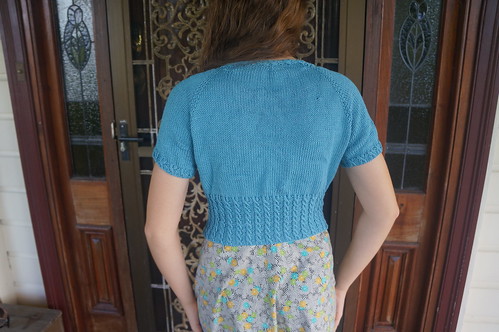
The pattern as written uses 5.5mm needles, and Just Bamboo yarn, giving a loose open texture at about a 10ply stitch count. As you can see, the very smart camisole top here has a quite close and firm texture, minimizing see through in such a cool-to-wear top. It is knit from Class yarn (8ply, viscose/cotton) shade Bahama Blue on 4mm needles, and fits very nicely.
Jennie knit a tension swatch on 4ply needles and we worked out that as her row height was a little less than standard for her stitch count, she could simply increase the dress size chosen (up by 3 sizes in this case) rather than recalculate the entire pattern. When doing this it is important to check that not just girth changes, but the height changes of the garment, particularly when increasing or decreasing by row number rather than garment height in cm. Fortunately for our calculation tolerance, there is very little shaping in this garment, and the armholes are measured in cm, not in rows, so Jenni could essentially follow the pattern and end up with a well fitting garment.
The pattern as written uses 5.5mm needles, and Just Bamboo yarn, giving a loose open texture at about a 10ply stitch count. As you can see, the very smart camisole top here has a quite close and firm texture, minimizing see through in such a cool-to-wear top. It is knit from Class yarn (8ply, viscose/cotton) shade Bahama Blue on 4mm needles, and fits very nicely.
Jennie knit a tension swatch on 4ply needles and we worked out that as her row height was a little less than standard for her stitch count, she could simply increase the dress size chosen (up by 3 sizes in this case) rather than recalculate the entire pattern. When doing this it is important to check that not just girth changes, but the height changes of the garment, particularly when increasing or decreasing by row number rather than garment height in cm. Fortunately for our calculation tolerance, there is very little shaping in this garment, and the armholes are measured in cm, not in rows, so Jenni could essentially follow the pattern and end up with a well fitting garment.
Friday, October 30, 2009
Sharon's Handwarmers
Some of you may know that Sharon, who works here, has just been to Japan in order to await the arrival of her first grandbaby. At last she is back! (I really missed her).
Now I do not yet have photographs of her gorgeous grandson modelling her knitting, apparently he needs to grow a little first, and the weather needs to cool down in Japan, but I do have some photographs of some of her other gift knitting.

Sharon made several pairs of these handwarmers - her own pattern, using Jo Sharp Silkroad Aran Tweed yarn. These are made from shade Imagine, 145. She makes one pair from a 50g ball. Don't you love the cables?
Now I do not yet have photographs of her gorgeous grandson modelling her knitting, apparently he needs to grow a little first, and the weather needs to cool down in Japan, but I do have some photographs of some of her other gift knitting.

Sharon made several pairs of these handwarmers - her own pattern, using Jo Sharp Silkroad Aran Tweed yarn. These are made from shade Imagine, 145. She makes one pair from a 50g ball. Don't you love the cables?
Wednesday, October 28, 2009
Sirdar Denim Tweed DK Jumper
I started this jumper because the pattern is terrible. That sounds strange, but a lovely Dutch lady came into the shop a few months ago, asking for help with a free pattern she had collected at Spotlight. She thought that maybe her English-as-a-second-language was the reason for her confusion with the instructions. She booked a lesson to work on this pattern and to learn how to do cables.
Her English was just fine. I did wish my Dutch was better (ie existant) though, as she whipped out some really interesting Dutch pattern books with cable charts for me to demonstrate to her.
The Spotlight pattern was simply full of mistakes. However, I am not good at picking up every mistake just by reading a pattern, I have to knit it. Once I had worked out the kinks, I loved the wave ruffle at the bottom of the jumper sleeves and body, and my daughter adored the subtle pink and purple self striping of the yarn.As I had not planned this garment in my winter knitting, I put the started ruffle and a bit of Sirdar Denim Tweed away for a while, but have just finished the jumper ready for next year.
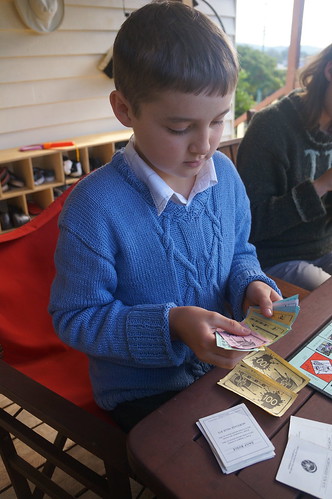
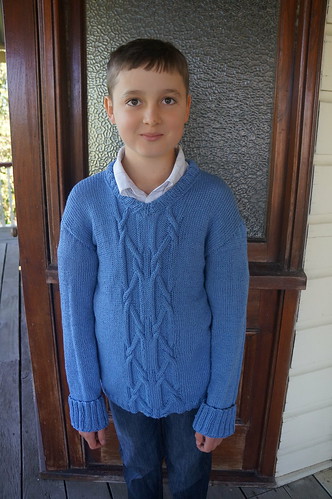
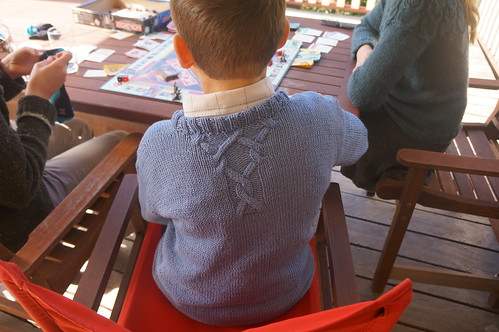
We like the horseshoe cable up the front. I have changed the dimensions of the cable panel to fit the wave border.
The all over rib makes this a sung but comfortable fit.
I changed the picking up instructions for the neck, and the transition of the cable to the neck ribbing.
This jumper used 5 and 1/2 50g (170m)balls of Sirdar Denim Tweed DK, shade 651 Lavender.
Her English was just fine. I did wish my Dutch was better (ie existant) though, as she whipped out some really interesting Dutch pattern books with cable charts for me to demonstrate to her.
The Spotlight pattern was simply full of mistakes. However, I am not good at picking up every mistake just by reading a pattern, I have to knit it. Once I had worked out the kinks, I loved the wave ruffle at the bottom of the jumper sleeves and body, and my daughter adored the subtle pink and purple self striping of the yarn.As I had not planned this garment in my winter knitting, I put the started ruffle and a bit of Sirdar Denim Tweed away for a while, but have just finished the jumper ready for next year.
We like the horseshoe cable up the front. I have changed the dimensions of the cable panel to fit the wave border.
The all over rib makes this a sung but comfortable fit.
I changed the picking up instructions for the neck, and the transition of the cable to the neck ribbing.
This jumper used 5 and 1/2 50g (170m)balls of Sirdar Denim Tweed DK, shade 651 Lavender.
Tuesday, October 27, 2009
Starting young
Monday, October 12, 2009
Smocking, AS&E 84
I do not usually smock from a pattern plate, as there are a lot of my own designs lurking in my head, that I would like to make into real garments one day, but this pretty design by Kathy Dykstra caught my eye in issue 84 of Australian Smocking and Embroidery, and I had started it before I could be sensible about my project list! I am not very good at being sensible about my project list.

I am making this size 2 dress in pink imperial batiste fabric (the dress in the magazine is in blue dotted Swiss voile), so changed the colour of the background smocking to green, but have used the same shades of pink for the flowers as published in the magazine.
At this point I am leaving the smocking to mature for a little while whilst I decide whether or not to trim the dress with entredeux and 4 strips of lace as shown in the magazine. I love the look of heirloom clothing, but I also like the garments I make to be worn at some point - so maybe I will choose a thinner lace to make the care of the garment more simple for the undoubtedly busy mother of a two year old.

I am making this size 2 dress in pink imperial batiste fabric (the dress in the magazine is in blue dotted Swiss voile), so changed the colour of the background smocking to green, but have used the same shades of pink for the flowers as published in the magazine.
At this point I am leaving the smocking to mature for a little while whilst I decide whether or not to trim the dress with entredeux and 4 strips of lace as shown in the magazine. I love the look of heirloom clothing, but I also like the garments I make to be worn at some point - so maybe I will choose a thinner lace to make the care of the garment more simple for the undoubtedly busy mother of a two year old.
Subscribe to:
Posts (Atom)